Why Your Product Data Strategy is Costing You Market Share
The Hidden Cost of Disconnected Product Data
Most building product manufacturers manage separate workflows for photography, BIM content, technical drawings, web assets, and marketing materials. Each channel has its own vendor, its own timeline, and its own version of the truth. The result is inconsistency, delays, and a digital presence that lags behind competitors who have unified their content pipeline. In a market where specifiers increasingly choose products based on digital availability, a fragmented data strategy is a direct revenue risk.
The BIM-First Approach
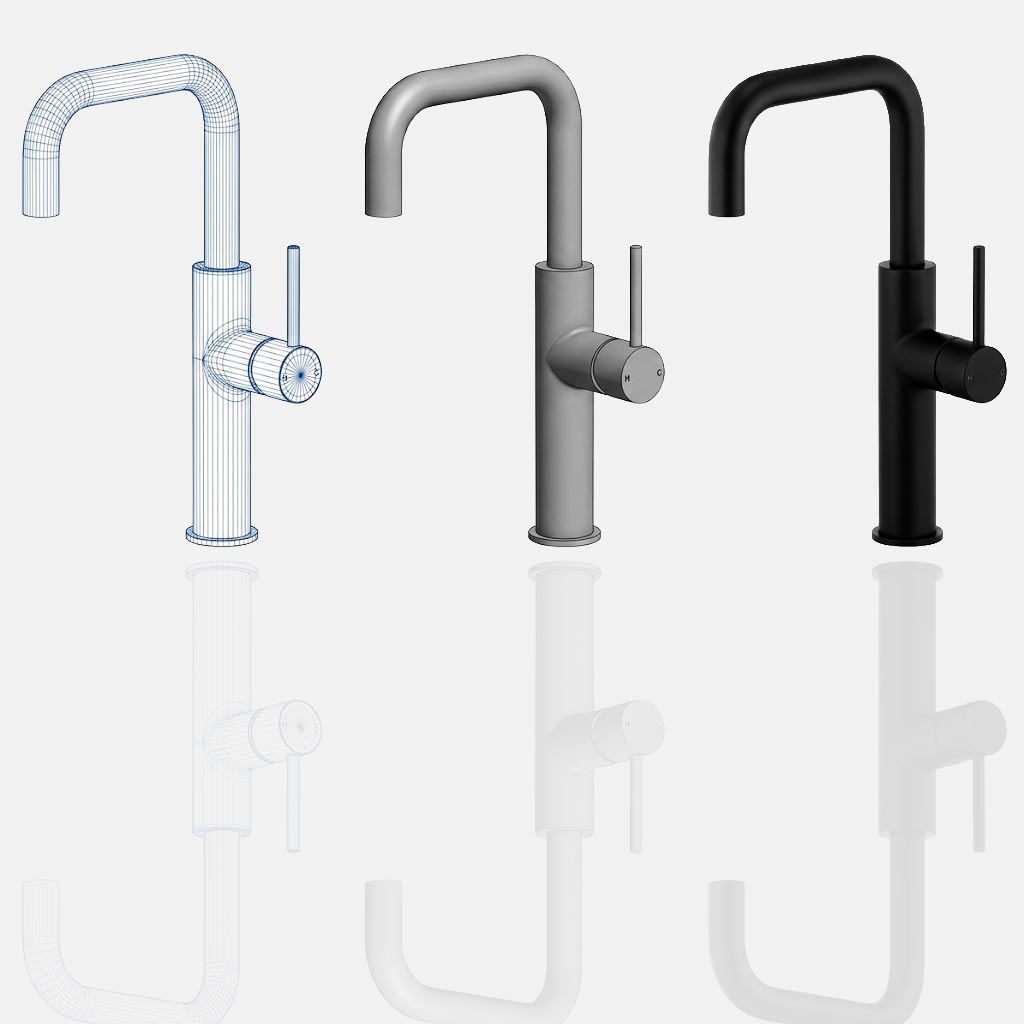
The most efficient path to multi-channel product content starts with a high-quality BIM model as the single source of truth. A properly constructed parametric model contains the geometry, materials, metadata, and configurability rules that every downstream output needs. From that one asset, you can generate CGI product imagery, 360-degree turntables, AR/VR experiences, web configurators, technical drawings, and specification sheets. One investment, every channel covered.
Why Traditional Photography is Losing Ground
A single product photography shoot can cost thousands of dollars per SKU when you factor in studio hire, lighting rigs, styling, post-production, and the logistics of shipping physical samples. Now multiply that across a catalogue of hundreds or thousands of SKUs. CGI and our Signature Product Imagery workflow replaces all of that: producing photorealistic visuals in any environment, any angle, any configuration, at a fraction of the cost and timeline.
Scaling Content for the Full Product Range
The real power of a BIM-first strategy emerges at scale. Once the parametric model and material library are established, rolling out content for new SKUs or product variants becomes a production pipeline rather than a bespoke project. Batch automation handles geometry variants, colour options, and accessory configurations. What once required individual attention for every product variant now runs through a system that maintains quality while dramatically reducing per-unit cost.
Measuring the Impact
Manufacturers who unify their product data strategy see reduced time-to-market for new products, higher specification rates from design consultants who find their BIM content easily accessible, and significant reductions in content production costs. The competitive edge is not just cost savings: it is market presence. Being the brand with the most accessible, highest-quality digital content across BIM platforms, e-commerce, and AR experiences directly influences specification decisions.
Related case studies


Need help implementing this in your projects?
We build production-grade systems, not theoretical frameworks. Let's discuss your specific challenges.