Digital Systems for AEC in the AI Era: What Is Possible Now, and How to Build It
The AI boom is reshaping AEC procurement, delivery and operations, but the studios and contractors who are converting AI into outcomes are not the ones running the most pilots. They are the ones who have already invested in a unified data ecosystem: clean information, governed standards, and integrated tooling. This article maps what digital systems can realistically deliver in 2026, the four-layer reference architecture that underpins reliable AI, and the staged investment path from cleaning up your data to running autonomous workflows.
Why the AI boom is making the digital basics matter more, not less
Every major AEC vendor now leads with AI in its marketing. The instinct in leadership rooms is to chase pilots. The pattern we see across our delivery work is the opposite: the studios converting AI investment into measurable outcomes are the ones who already had clean data, governed standards, and integrated tooling. AI amplifies whatever it is built on. Built on a unified data ecosystem, it accelerates. Built on fragmented files and inconsistent standards, it produces confident nonsense at scale. The first investment in the AI era is not AI; it is the substrate AI needs.
What digital systems can realistically deliver in 2026
We separate realistic capability from marketing in five categories. Information management: end-to-end ISO 19650 alignment, CDE-driven workflows, automated container governance. Design and engineering: parametric and computational pipelines, automated documentation, AI-assisted compliance checking, retrieval-augmented question answering on project data. Delivery and construction: federated coordination at scale, prefabrication tracking, autonomous progress monitoring on stable site conditions, robotic and CNC fabrication from clean digital geometry. Asset operations: data-rich digital twins, condition monitoring, sensor integration into the asset information model. And business operations: BI dashboards over project performance, automated reporting, integrated procurement and supply chain data. All of this is deliverable today by capable teams. None of it is delivered well without an underlying data architecture.
The four-layer reference architecture
We design AEC digital systems on a four-layer architecture. Layer one is the information layer: the BIM models, drawings, documents, schedules and sensor data, all governed by ISO 19650 information containers in a CDE. Layer two is the integration layer: the pipes that move information between authoring tools, the CDE, internal databases, project management systems, and downstream consumers. Layer three is the automation layer: the tooling that does deterministic work on top of the information (audits, extractions, reports, fabrication outputs). Layer four is the intelligence layer: AI, ML, agents, and visual analytics that work on top of the cleaned, integrated, and automated foundation. Most failed AI programmes try to add layer four without layers one to three. They do not work.
The unified data ecosystem pattern
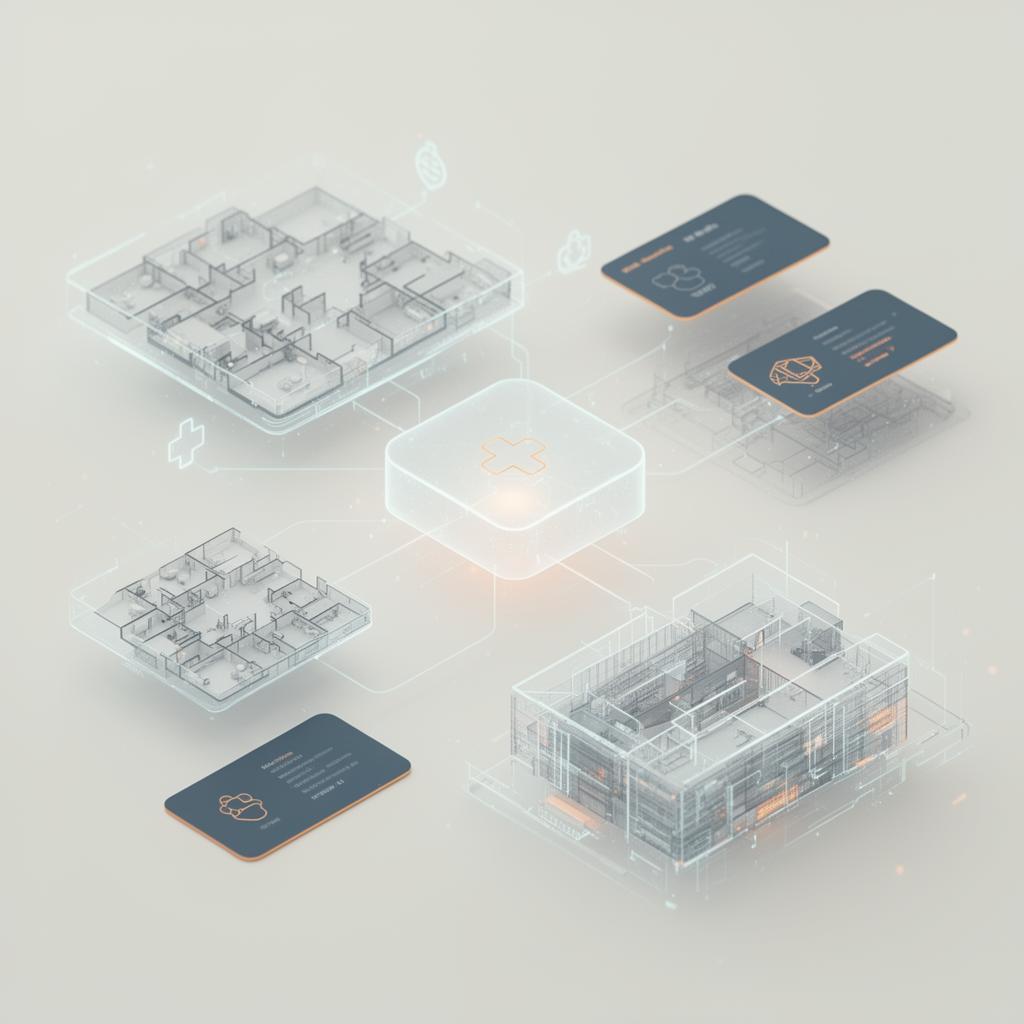
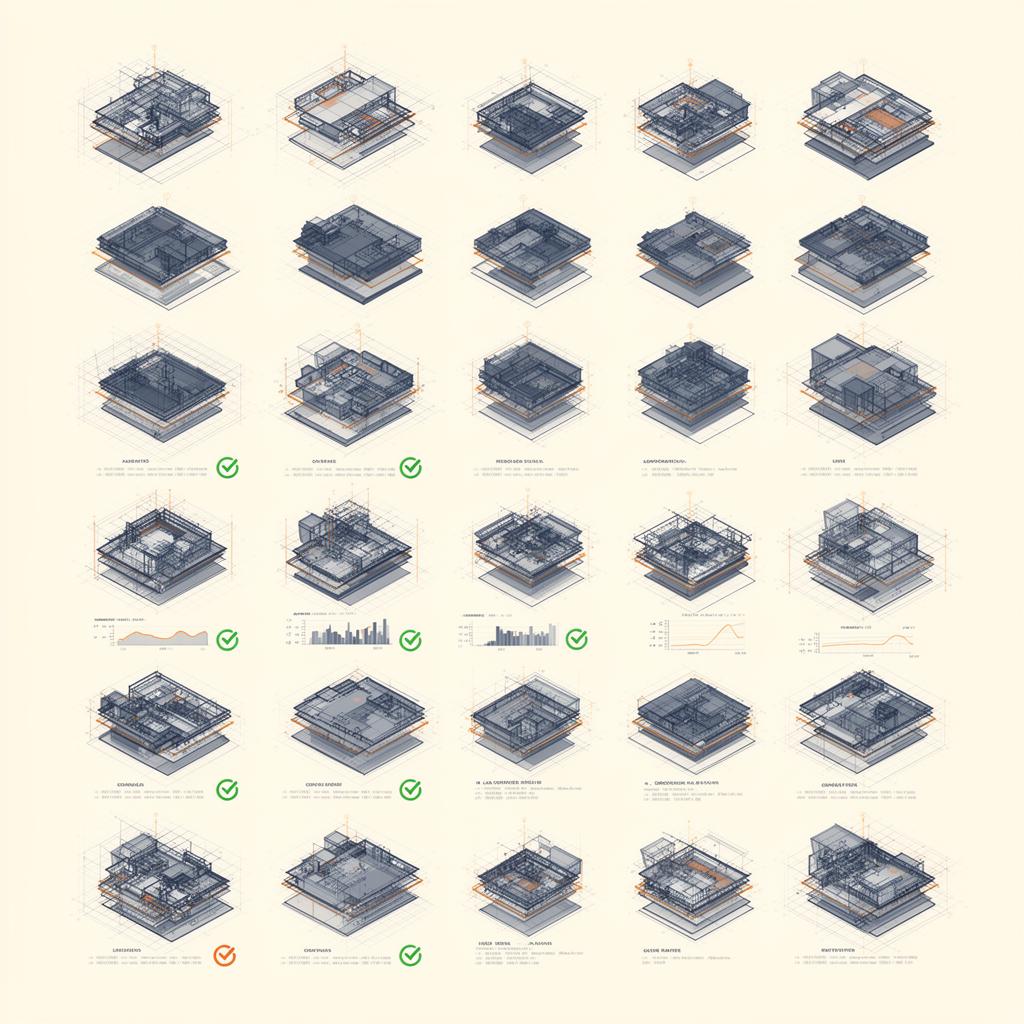
The unified data ecosystem is the pattern we use to make the four layers operationally real. It connects the authoring environment (typically Revit, Rhino, IFC-based exchange) with structured data sources (room data tools like dRofus, equipment registers, brief documents, regulatory references, and BI databases) through a governed integration layer. On our healthcare PPP work in Victoria, this pattern connected over twenty-five complex hospital models, the state-issued brief, the room data sheets, the equipment lists, and the assurance audits into one operational ecosystem. It is the pattern that makes AI useful, because AI needs information that is connected, not information that is merely stored.
How AI fits inside the ecosystem
AI in AEC delivers value when it sits on top of a unified data ecosystem and is scoped to bounded tasks. Compliance agents that parse regulations and validate models against rules. Retrieval-augmented generation systems where a specialist agent answers project-specific questions grounded in the project's own documents and models. Document classification and extraction that turns scanned drawings, schedules and briefs into structured data. Pattern recognition on point clouds and progress imagery to confirm built status. None of these require a frontier model. All of them require disciplined data. The right question to ask before investing in any AI tool is whether the data it needs already exists in a usable form. If the answer is no, the first investment is in the data.
Autonomous workflows: where they are real, and where they are still pilots
Real today: automated model audits running on a defined cadence, automatically generated assurance reports, scheduled fabrication outputs, automated clash reports filtered to the right discipline, periodic compliance checks against published rules, and automated data extracts feeding BI dashboards. Still pilots: end-to-end generative design that produces buildable outputs without human iteration, AI-driven coordination at the scale of a full Tier 1 project, and fully autonomous robotic site operations on dynamic sites. The boundary moves every six months. The shape of the boundary does not: deterministic, bounded, repetitive work is automatable now; open-ended, judgment-heavy work still needs a human in the loop.
A staged investment path
We recommend a staged path for studios and contractors investing in digital systems in the AI era. Stage one (months 0 to 6): clean and govern the information layer. Land ISO 19650 alignment, fix the CDE state model, standardise the templates, and publish the standards. Stage two (months 6 to 12): build out the automation layer for the highest-ROI repetitive tasks, with proper governance and version control. Stage three (months 12 to 24): stand up the integration layer so authoring tools, the CDE, and internal databases speak to each other reliably. Stage four (months 24+): add the intelligence layer with bounded AI workflows on top of the now-cleaned ecosystem. Studios that try to compress this into a single year usually deliver layer four on top of unfinished layer one, and then quietly retreat to slideware.
The role of leadership in the AI era
The digital systems decision is no longer a technology decision; it is a business decision. Leadership has to make three calls. First, what is in-house IP and what is bought or partnered. Second, what is the acceptable speed of change for the operating model, given how much delivery is in flight. Third, what is the measurement framework for success: recovered fee margin, hours saved, error rates, win rates, asset performance, or something else. Studios that answer these three questions clearly invest with discipline. Studios that do not, end up with a portfolio of unfinished pilots and a quietly nervous board.
What we help clients do, in practice
GIRIH X is an applied innovation studio for AEC and manufacturing. We do not sell software and we do not sell AI for the sake of AI. We help clients land ISO 19650-aligned information, build production-grade automation pipelines, stand up unified data ecosystems, and add bounded AI capabilities on top of them. The engagements that work are the ones where the client is honest about which layer they are actually at, and willing to invest there before investing further up the stack. The engagements that fail are the ones where leadership wants the AI press release before the data has been cleaned. The technical work is rarely the bottleneck. The discipline of building in the right order is.
Frequently asked questions
Is AI ready to deliver real value in AEC today?
Yes, but only for bounded, repetitive, rule-driven tasks built on top of disciplined data. Compliance checking, document extraction, retrieval-augmented question answering on project data, and pattern recognition on imagery all work in production. Open-ended generative work that replaces design judgment does not, and probably will not in this decade.
Do we need to clean our data before investing in AI?
Almost always, yes. AI built on inconsistent, fragmented data produces confident-sounding outputs that mislead teams. The single highest-ROI investment for most studios entering the AI era is information governance and a unified data ecosystem. Without that, AI investment is a multiplier on existing chaos.
What is a digital twin in this context?
A digital twin is a data-rich, lifecycle-aware digital representation of a built asset that is kept in sync with the physical asset through sensor and operational data. In an ISO 19650-aligned operating model, the digital twin is the layer on top of the operational phase information container set, not a separate system. Without a clean handover under part 3 of the standard, most digital twin programmes spend their first year cleaning data that should have been delivered.
How long does a unified data ecosystem take to stand up?
On a single major project, 6 to 12 months for the first useful version, with continuous maturation after that. For a studio standing it up as an operating model across multiple projects, plan for a 12 to 24 month roadmap with measurable milestones each quarter. Compressing this further usually produces a presentation rather than a working system.
What is the difference between digital transformation and digital systems?
Digital transformation is the strategic narrative. Digital systems are the engineered reality underneath it. Transformation without systems is rebranding. Systems without transformation is technology in search of a business case. Both are required, and the order matters: in our experience, transformation narratives that come before the system blueprint do not survive contact with delivery.
Where does GIRIH X actually help?
We help clients land the substrate: ISO 19650-aligned information, production-grade automation, unified data ecosystems, and bounded AI workflows on top of them. We do not sell software. We do not sell AI as a slogan. The engagements that work are the ones where we are invited in early enough to fix the foundation, not late enough to repaint the surface.
Related services
Related case studies

Need help implementing this in your projects?
We build production-grade systems, not theoretical frameworks. Let's discuss your specific challenges.